Habits
Why a goal you can see is a goal you keep
Goals rarely end with a big failure. They end quietly, the week you stop thinking about them. What the research says about keeping a goal in sight, and why a doll with one eye does it so well.

The short answer
To stick to a goal, keep it in sight and keep track of it. A review of 138 studies found that monitoring your progress makes you more likely to reach a goal, especially when the progress is physically recorded or shared with others. Planning when and where you'll act also helps a lot. A Daruma does several of these things at once. You commit by painting one eye, it sits where you see it every day, and the half-painted face records where you are.
Think of a goal you set and didn't reach. Chances are it didn't end with a dramatic failure. There was no day you decided to give up. It just slipped. One busy week, then another, and one day you noticed you hadn't thought about it in a month.
That is the quiet way most of our goals end. Not with a bad day, but with no day at all.
A Daruma is built against exactly that. Once you have painted its first eye, it sits on your shelf looking at you with one eye, every day, until you finish. It's a strange little object. It also happens to do several of the things that research says help people keep a goal.
Why do we forget our goals?
Because nothing reminds us. A goal in your head or in a notes app has no cue. It only comes back when you happen to think of it.
James Clear, the author of Atomic Habits, makes the case that the cues for good habits should be obvious and in plain sight, because we act on what we notice. His advice is to design your surroundings so the best choice is the easiest one to make. Leave the running shoes by the door, and the run becomes the obvious next step.
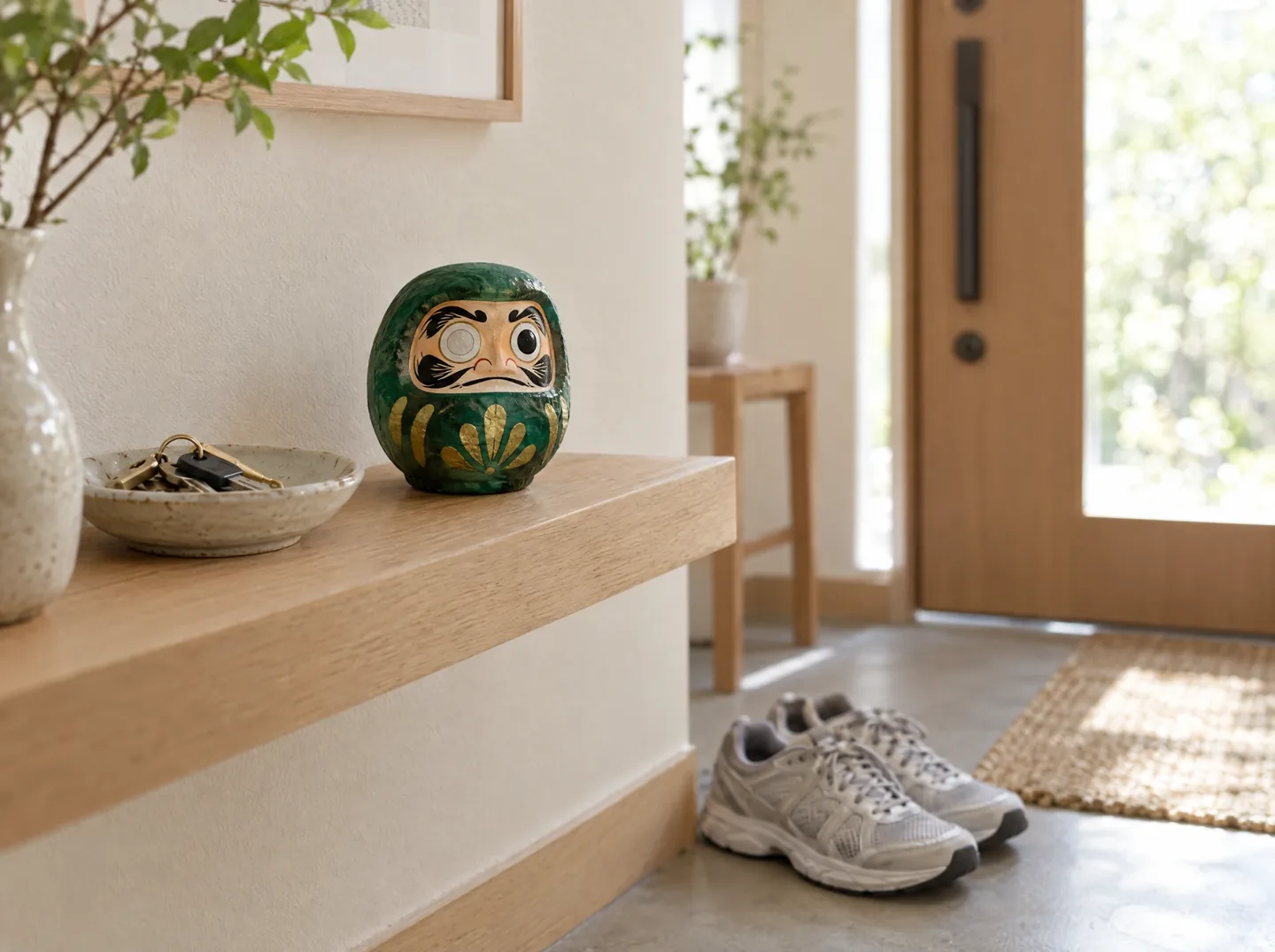
A goal can work the same way. If it sits on your daily route, you meet it every day whether you remember it or not.
What does the research say about keeping track?
Tracking your progress makes you more likely to reach a goal, especially if the record is physical or other people can see it. A team at the University of Sheffield reviewed 138 studies with nearly 20,000 participants, mostly on health goals like losing weight, eating better or quitting smoking. People who were prompted to monitor their progress did better, and those who monitored more often did better still.
Two details stood out. The effect was larger when progress was physically recorded, and larger again when it was reported publicly. Writing it down counts. So does having someone else see it.
A Daruma does both. The half-painted face is a record you can see from across the room. And anyone who visits will ask why your doll only has one eye.



Why does painting the first eye matter?
It turns an intention into a commitment. Economists call a step like this a commitment device, something you do now that binds your future self to a plan. Some commitment devices are hard, with money at stake. Others are soft, and the cost of quitting is mostly the feeling of breaking your word.
The first eye is a soft one. Nothing happens if you give up, except that a doll keeps looking at you with one eye. For a lot of people, that turns out to be enough.
Plan when, not just what
Deciding exactly when and where you will act makes a goal much more likely to happen. Psychologists call these implementation intentions, plans in the form "When this happens, I will do that." A review of 94 tests found they had a medium-to-large effect on reaching goals.
So don't stop at the goal. Give it a trigger.
- "When I see the Daruma by the door on a weekday morning, I put on my running shoes."
- "When I sit down at my desk after lunch, I write for twenty minutes before opening email."
- "When I put the kettle on in the evening, I do ten minutes of Spanish."
Write your plan on a slip of paper and tuck it under the doll, so the cue and the plan sit in the same place.
How long until it sticks?
Longer than three weeks, and that's fine. In a study at University College London, it took participants 66 days on average for a new daily behavior to become automatic. Some got there in 18 days. For others it would have taken an estimated 254.
The most useful finding was a different one. Missing a single day had little effect. One bad day doesn't send you back to the start.
That is the Daruma's whole personality. Push it over and it rocks, wobbles and stands back up. Fall seven times, get up eight.
How to set up a goal you'll see every day
One sentence, one plan, one eye, one shelf. Here is the whole setup.
- Write the goal in one sentence, with a clear finish line. "Run 10 kilometers without stopping" has an ending. "Get fit" doesn't.
- Add an if-then plan. When and where will you act? Write it down.
- Paint the first eye. The Daruma's left eye, the one on your right as you face it. Our guide on how to use a Daruma covers the details.
- Put it on your daily route. By the door, on your desk, next to the kettle. Not in a drawer.
- Tell someone. Progress you share is progress you keep.
- Paint the second eye when you get there. Do it with the person who watched you work for it.
Do it with someone
The strongest version of all this has a witness built in. Two people, two goals, two dolls side by side on a shelf. Each of you can see the other's progress at a glance, and whoever paints a second eye first has to wait for the other one.

That is why The Pair holds two Daruma in any two colors, with a marker for the eyes and the ritual printed inside the lid. One for you, one for the person keeping you honest.
Starting at New Year? Read about the Japanese New Year ritual that the Daruma is part of.
Questions
What is the best way to stick to a goal?
Keep track of your progress and keep the goal visible. A review of 138 studies found that monitoring progress makes people more likely to reach their goals, and the effect is larger when progress is physically recorded or reported to others. Planning exactly when and where you will act helps too.
What is an if-then plan?
An if-then plan, or implementation intention, links a situation to an action, for example "When I get home from work, I put on my running shoes." A review of 94 tests found these plans have a medium-to-large effect on reaching goals.
How long does it take to form a habit?
In a well-known study, it took participants 66 days on average for a new daily behavior to become automatic, with a range from 18 to 254 days. Missing a single day had little effect on the result.
Is the Daruma backed by science?
We don't know of any study that tests Daruma dolls themselves. What the research does support are the things a Daruma does, such as making a commitment, keeping a goal in sight and recording progress where you and others can see it.
Is this the same idea as Atomic Habits?
It's related. James Clear, the author of Atomic Habits, argues that the cues for good habits should be obvious and in plain sight. A Daruma on your shelf is one way to make a goal obvious.
Sources
- Does monitoring goal progress promote goal attainment? (press release), American Psychological Association, on Harkin et al., Psychological Bulletin (2016)
- Implementation intentions and goal achievement: a meta-analysis of effects and processes, Gollwitzer and Sheeran, Advances in Experimental Social Psychology (2006)
- How long does it take to form a habit?, British Psychological Society Research Digest, on Lally et al. (2010)
- How to design your environment for success, James Clear
- Commitment devices, Bryan, Karlan and Nelson, Annual Review of Economics (2010)
Written by The Orunoki team. We check every fact against the sources above and update the article when we learn more. Last updated .