New Year
A New Year ritual for resolutions that last
In Japan the year starts with a brush, a doll with blank eyes and a bonfire. What that ritual gets right about resolutions, and how to borrow it.
The short answer
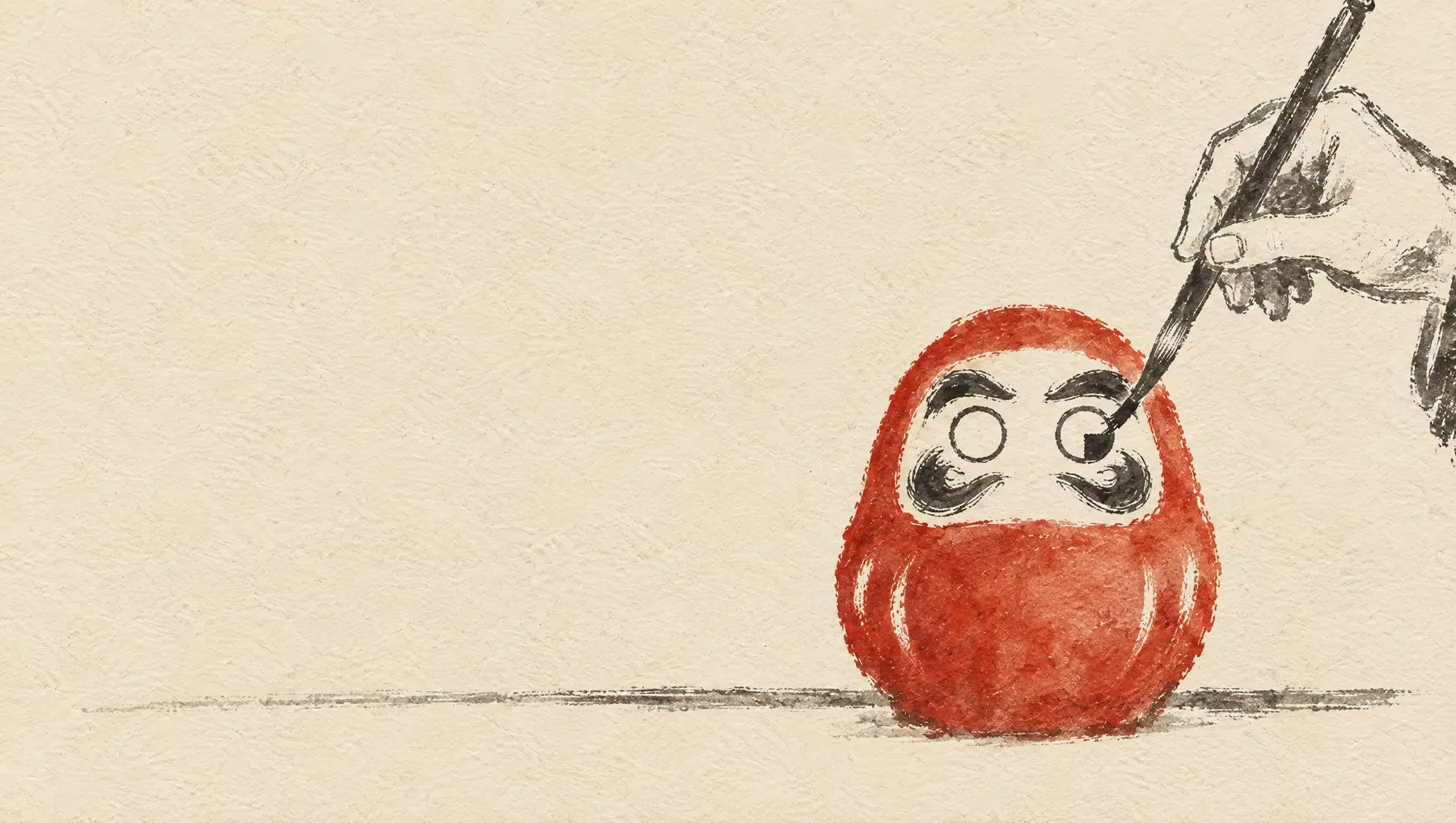
New Year's resolutions work more often than their reputation suggests. In a study of 1,066 people, 55 percent considered themselves successful a year later, and goals framed as something to start did better than goals framed as something to stop. In Japan, the New Year has its own ritual for this. People buy a Daruma with blank eyes at January temple markets, paint one eye for the year's goal, and paint the second when it's done.
Most New Year's resolutions are made late at night, on a phone, somewhere between the countdown and bed. A list of five things. By February, nobody can find the list.
In Japan, the start of the year looks different. In the first days of January, people sit down with a brush and ink and write the year's first words by hand. At temples, stalls fill with rows of red Daruma dolls, every one of them with blank white eyes. People choose one, take it home and paint in a single eye for the thing they want the year to bring. The other eye waits.
It is a resolution you can hold in your hand. And the research on resolutions suggests the ritual gets several things right.
Do New Year's resolutions actually work?
More often than their reputation suggests. In a Swedish study of 1,066 people, published in 2020, 55 percent considered themselves successful a full year after making their resolution. An earlier American study, cited in the same paper, found that 46 percent of people who made a resolution were still succeeding six months later. Among people who wanted the same kind of change but made no resolution, the figure was 4 percent.
So the joke about resolutions failing by February is only half the story. Making one seems to help. The question is how to make one that holds.
Why the New Year is a good time to start
A new year feels like a clean page, and that feeling is useful. Researchers at the Wharton School called it the fresh start effect. They found that Google searches for "diet," visits to a university gym and sign-ups for goal contracts all rise at the start of a new year. They also rise at the start of a new week or month, and after birthdays.
Their explanation is that landmarks like these divide time into chapters. Last year's slips belong to last year's chapter. The new one starts clean. That's a big part of why the first week of January feels so full of possibility, and why a ritual on that day can carry so much weight.
How the New Year begins in Japan
The Japanese New Year has a ritual for each part of a resolution: letting go, writing it down and committing to it.
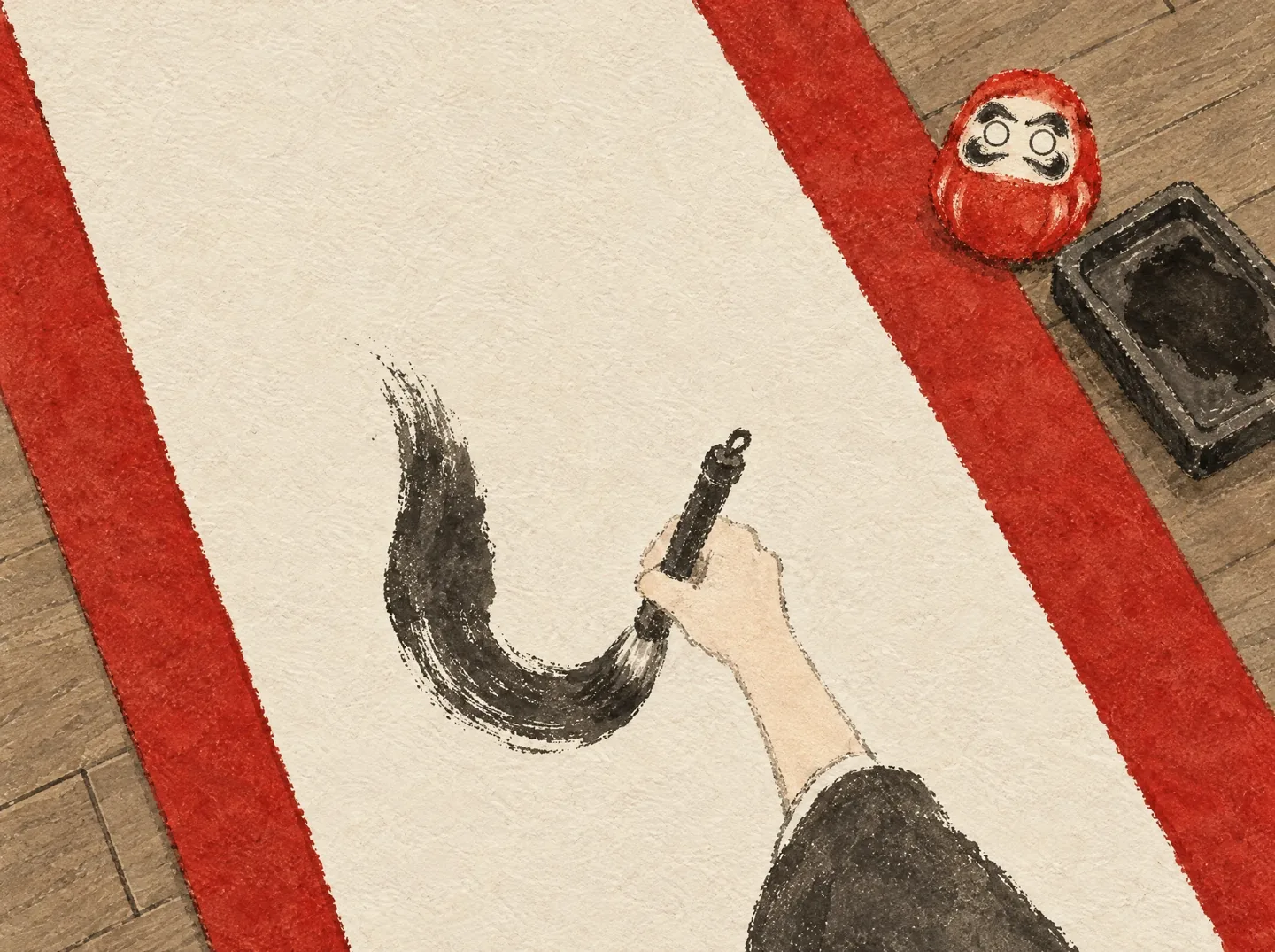
- Writing it down. Kakizome is the first brush writing of the new year, done in the first days of January. It is slow and deliberate, one sheet, one attempt.
- Choosing a Daruma. Temple markets sell Daruma through January. Kitain Temple in Kawagoe holds its Daruma market on January 3, and Shorinzan Darumaji in Takasaki, the home of the modern Daruma, holds its fair on January 6 and 7.
- Letting go. Around January 15, towns light bonfires called dondo-yaki, or sagicho, to burn the New Year decorations. People bring their kakizome too. Watching it burn and the smoke rise high is said to improve your writing. At Daruma temples, last year's dolls are returned and burned with thanks.
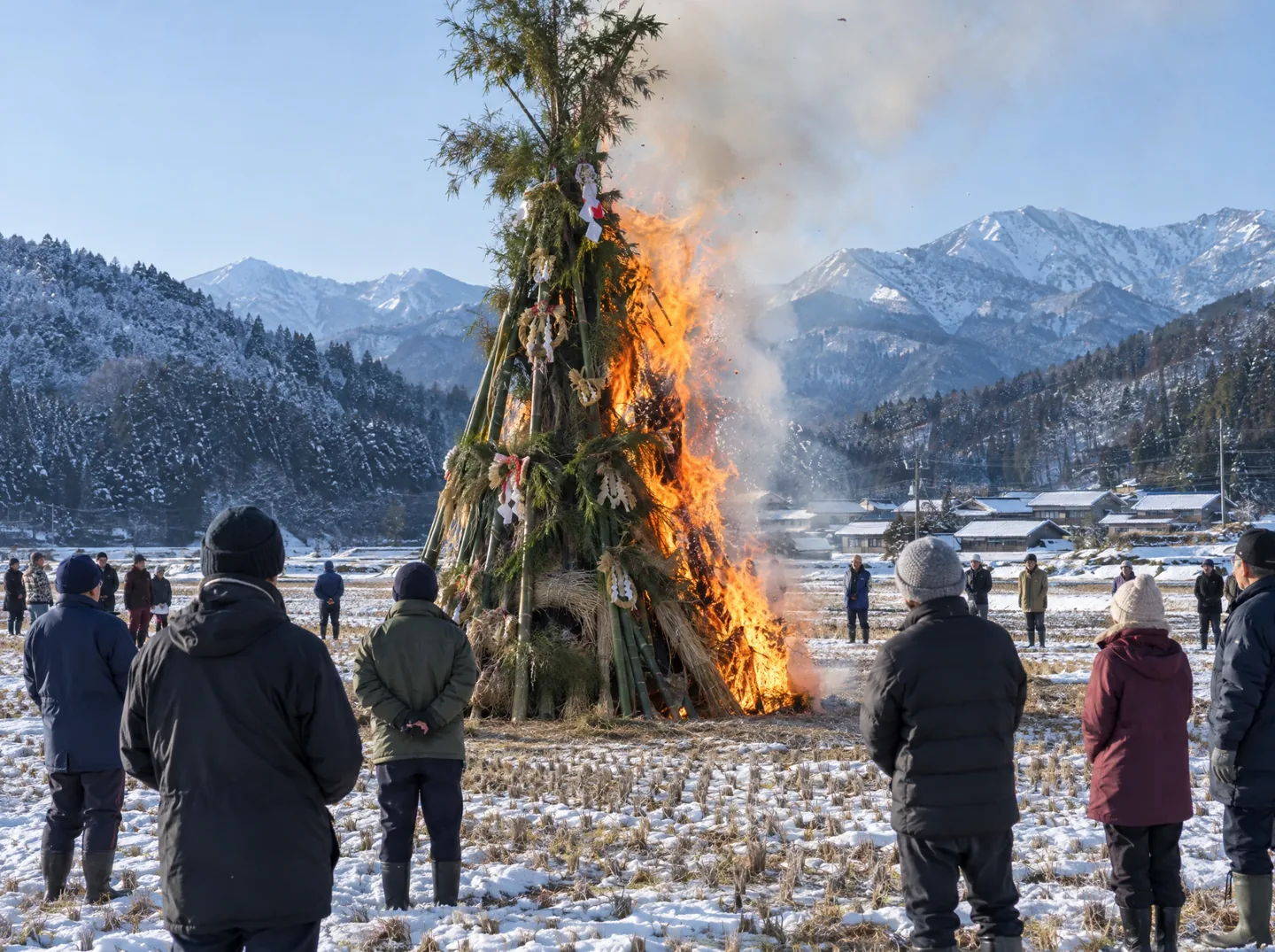
Put together, it is a complete cycle. Thank last year. Write this year's intention. Take home a doll with blank eyes and give one of them a purpose.
How to make a resolution that lasts
Choose one goal, write it by hand, frame it as something to do, and keep it where you will see it every day. Here is the Japanese ritual, adapted for a kitchen table anywhere.
- Close last year first. Before writing anything new, look back. What did last year's goals turn into? If you had a Daruma, thank it and let it go. The fresh start works better when the old chapter is actually closed.
- Choose one goal. One Daruma, one goal. A list of five is a wish list. One goal is a promise.
- Make it something to start, not something to stop. In the 2020 study, 58.9 percent of people with goals framed as doing something were successful, against 47.1 percent of people with goals framed as quitting or avoiding something. "Run three times a week" beats "stop being lazy."
- Write it by hand. Borrow the idea of kakizome. One sentence, written slowly, on paper or on the base of the doll.
- Paint the first eye. The Daruma's left eye, the one on your right as you face it. That is the commitment. Our guide on how to use a Daruma walks through it step by step.
- Put it where the year happens. By the door, on the desk, next to the kettle. A goal you see every day is harder to forget. We wrote about why that works.
- Decide what the second eye means. Before you start, agree with yourself what "done" looks like. That moment is the one you are working toward all year.
If February goes badly, do what the doll does. Tip it over and watch it stand back up. Fall seven times, get up eight.
A New Year ritual for the whole household
The New Year is a household holiday in Japan, and a Daruma works well shared. Give everyone a doll and let each person choose a color for their goal: gold for a money goal, green for health, pink for love, white for a good year, red for anything at all. Our color guide explains what each one means.
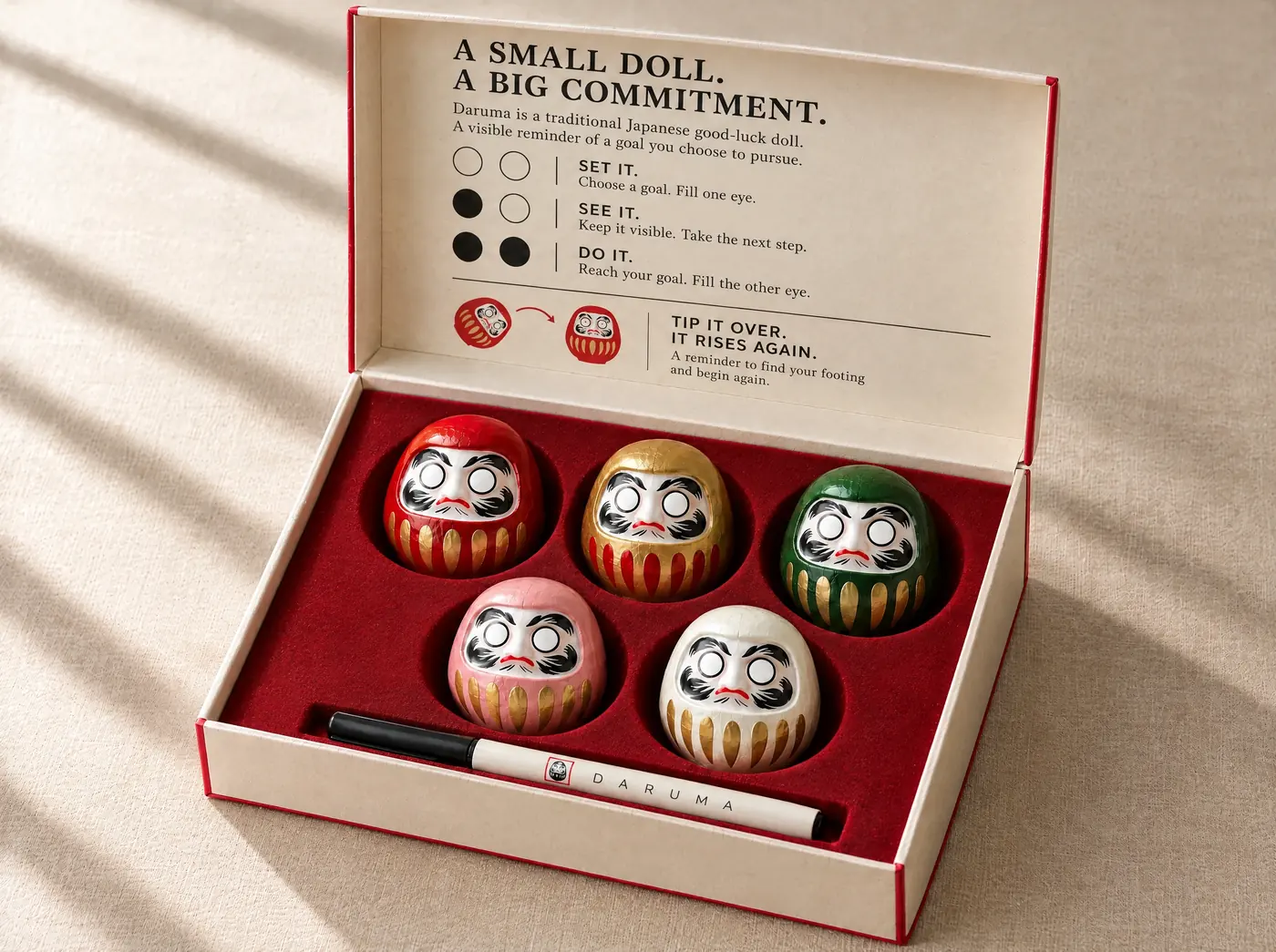
Line them up on one shelf. Over the year, you will see whose eyes fill in first. Next January, you will have five stories to tell before you thank the dolls and start again.
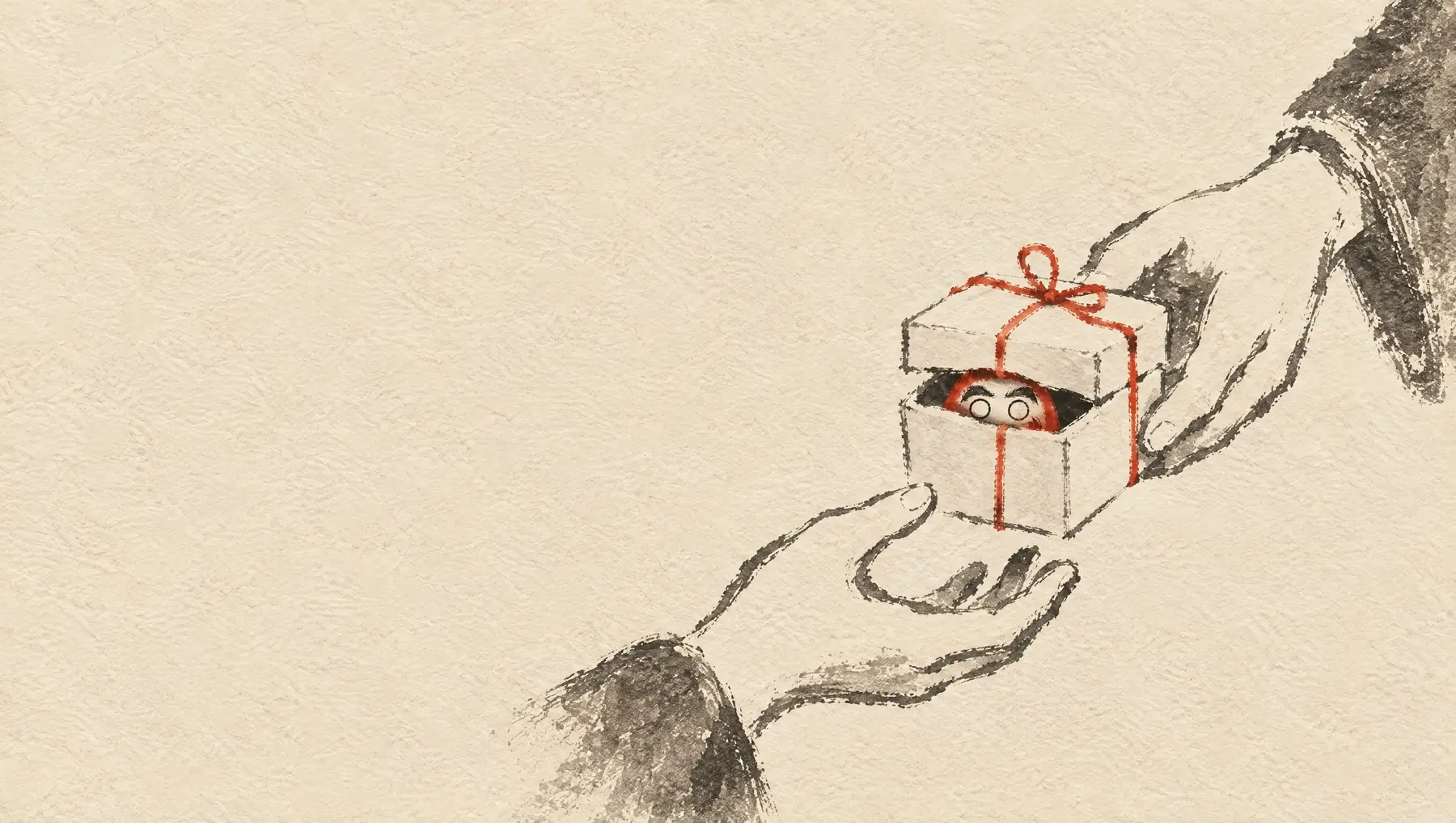
Giving one instead? A Daruma makes a natural New Year gift for someone starting a new chapter. Our gift guide has ideas for who to give one to and what to write in the card.
Questions
Do New Year's resolutions actually work?
Often, yes. In a 2020 study of 1,066 people, 55 percent considered themselves successful after a full year. An earlier study found that 46 percent of people who made a resolution were still succeeding at six months, compared with 4 percent of people who wanted to change but made no resolution.
When do people buy a Daruma for the New Year?
Traditionally in early January, at Daruma markets held at temples. Kitain Temple in Kawagoe holds one on January 3, and Shorinzan Darumaji in Takasaki holds its fair on January 6 and 7. Any time around the start of the year works. The ritual begins when you paint the first eye.
What is kakizome?
Kakizome is the first brush writing of the new year, done in the first days of January. In many places it is later burned at the dondo-yaki bonfire in mid-January, along with the New Year decorations.
What should I do with last year's Daruma?
Many people in Japan return it to a temple around the New Year, where it is burned with thanks, whether or not the goal was reached. If that isn't possible, say thank you and let it go respectfully, then start the year with a new doll.
Should a resolution be something to start or something to stop?
Something to start, where you can. In the 2020 study, 58.9 percent of people with goals framed as starting or doing something were successful, against 47.1 percent of people with goals framed as quitting or avoiding something.
Sources
- A large-scale experiment on New Year's resolutions, Oscarsson, Carlbring, Andersson and Rozental, PLOS ONE (2020)
- The fresh start effect: temporal landmarks motivate aspirational behavior, Dai, Milkman and Riis, Management Science (2014)
- Kitain Temple Daruma Market, Tobu Railway
- Daruma fairs (January), Kids Web Japan
- Dondoyaki, Japan Experience
- Living in Japan's traditions: Sagicho, Sakura House
- Japanese festival says thank you and goodbye to Daruma good luck dolls with fire, SoraNews24
Written by The Orunoki team. We check every fact against the sources above and update the article when we learn more. Last updated .