Guide
What is a Daruma doll?
A round red doll with blank eyes, a legend about a monk who would not move, and a small ritual for keeping a promise to yourself.
The short answer
A Daruma is a round, hollow Japanese doll, usually red, modeled on Bodhidharma, the monk said to have brought Zen to China. It comes with blank eyes. You paint one eye when you set a goal and the other when you reach it. Weighted at the base, it rights itself when knocked over, which has made it a symbol of perseverance across Japan.
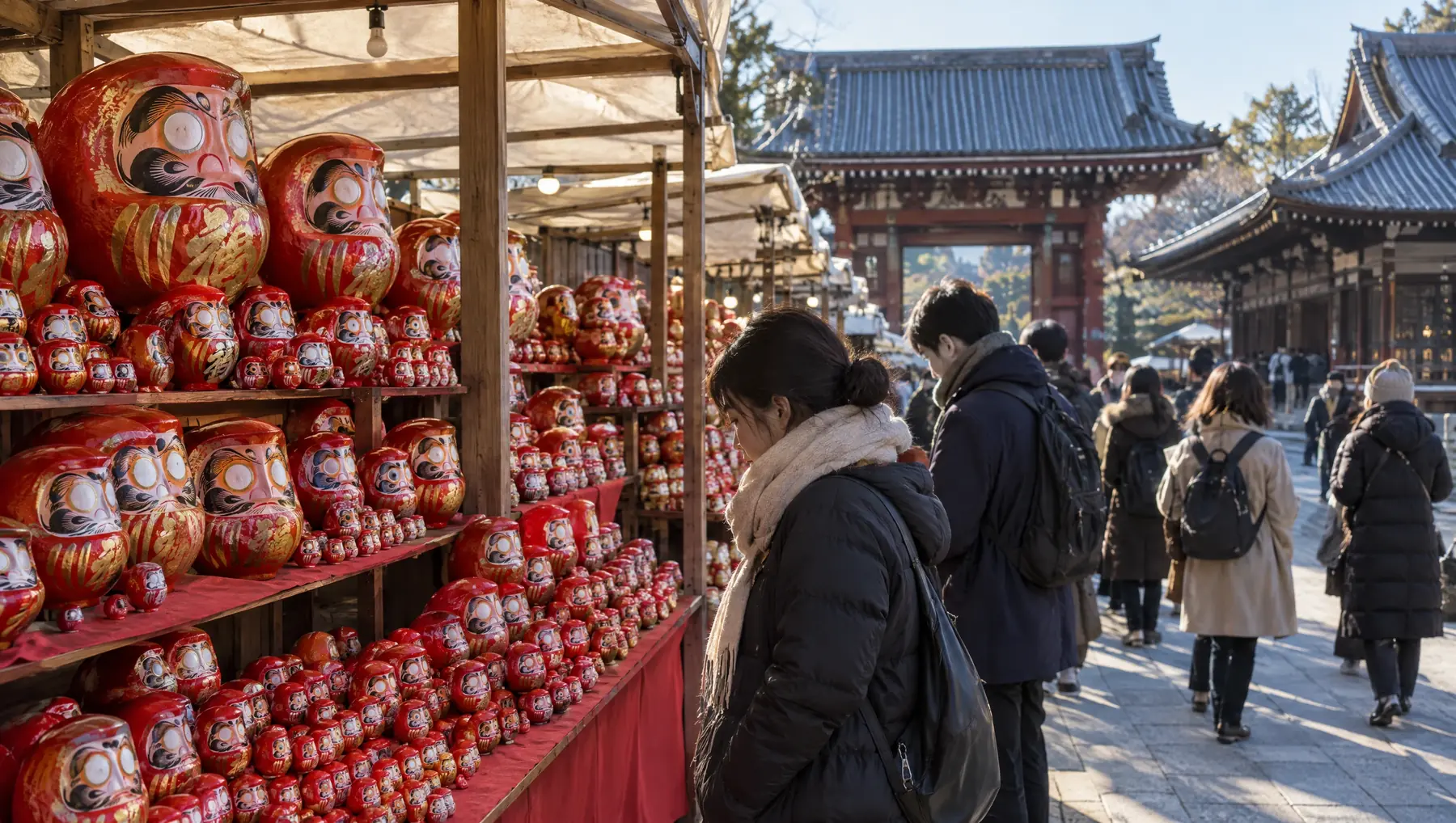
Every year on January 6 and 7, a Zen temple in Takasaki, about 100 kilometers northwest of Tokyo, fills with red. Around 110 stalls line the temple grounds. More than 300,000 people come through, and roughly 20,000 dolls leave in their arms. Many visitors also carry one in. It is last year's doll, often with both eyes painted, brought back to say thank you.
That doll is a Daruma. It has no arms, no legs and, when you buy it, no pupils. It is a good luck charm, a goal-setting tool and one of the simplest objects you will ever own. This guide explains where it comes from, what each part of it means, and why a doll with empty eyes has held on to people for more than two centuries.
Who was Daruma?
Daruma is the Japanese name for Bodhidharma, a Buddhist monk traditionally credited with bringing Zen to China around the 5th or 6th century. Very little written about him during his lifetime survives. Most of what people know comes from later accounts, and those are full of legend.
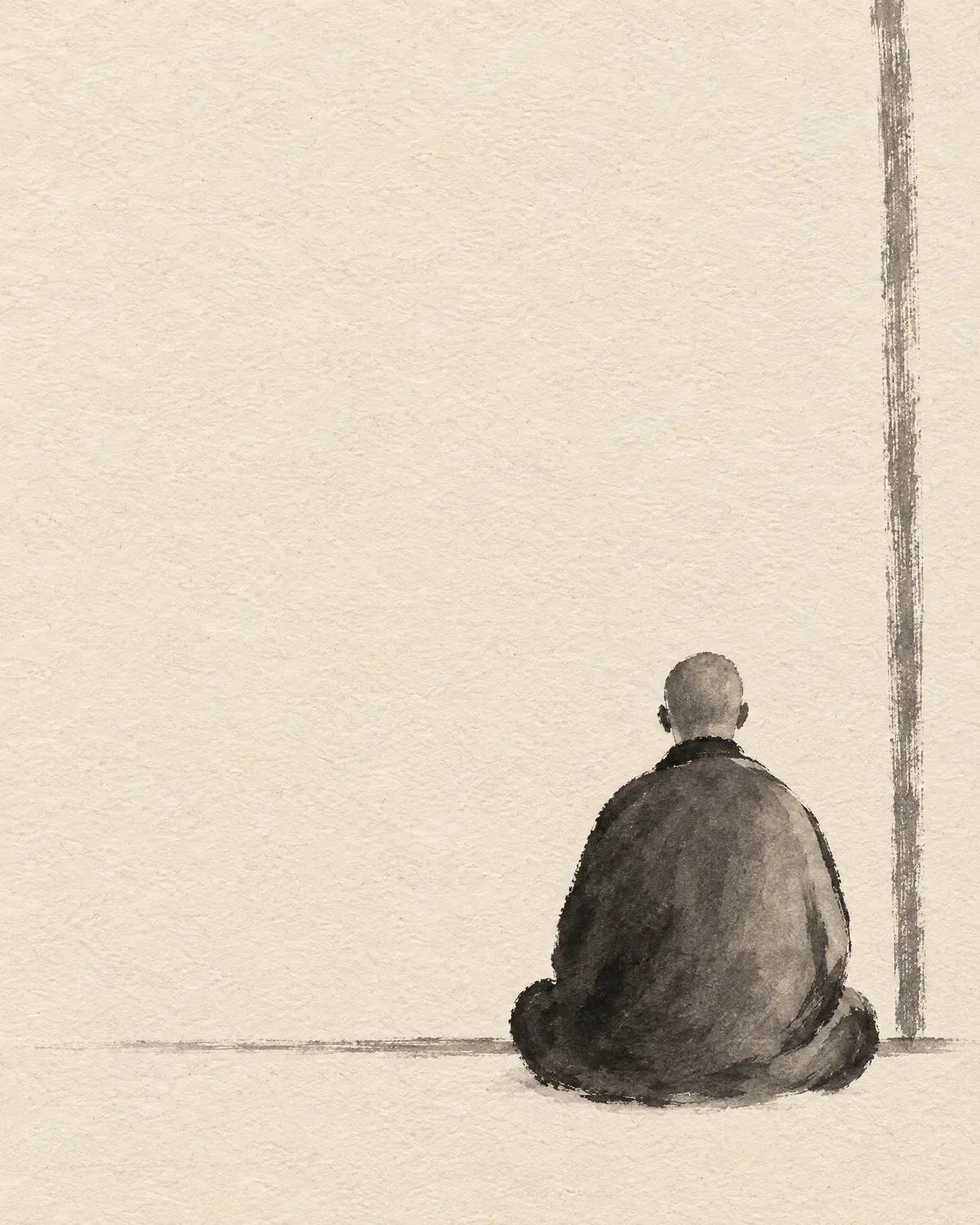
The best-known legend is the one the doll is built on. Bodhidharma, the story goes, sat facing a wall in meditation for nine years. He sat so long and so still that his arms and legs gave out. A second legend, harder to picture, says he cut off his own eyelids so he would never fall asleep in meditation again.
Neither story is history in any strict sense. Both describe something people recognize, though: a commitment so complete that nothing else is left over.
Why does a Daruma have no arms or legs?
The round, limbless body recalls Bodhidharma after his nine years at the wall. It also makes the doll a self-righting toy. A Daruma is hollow and weighted at the base, so when you tip it over, it rocks and stands back up.
Self-righting toys are older than the Daruma. A version called okiagari-kobōshi, roughly "the little priest who gets back up," was popular in the Kinki region around Kyoto and Osaka by the mid-1600s, and is said to have come to Japan from China. At some point the getting-up toy and the monk who would not move became the same object. The shape changed slowly, from a seated figure to an elongated, cocoon-like form, and finally to the round doll sold today.
That is where the doll's motto comes from: nanakorobi yaoki, fall seven times, get up eight.
Where does the Daruma doll come from?
The round Daruma we know today is tied to one temple: Shorinzan Darumaji, a Zen temple in Takasaki, Gunma Prefecture, founded in the late 1600s. Its early priests gave out images of Bodhidharma as New Year charms.
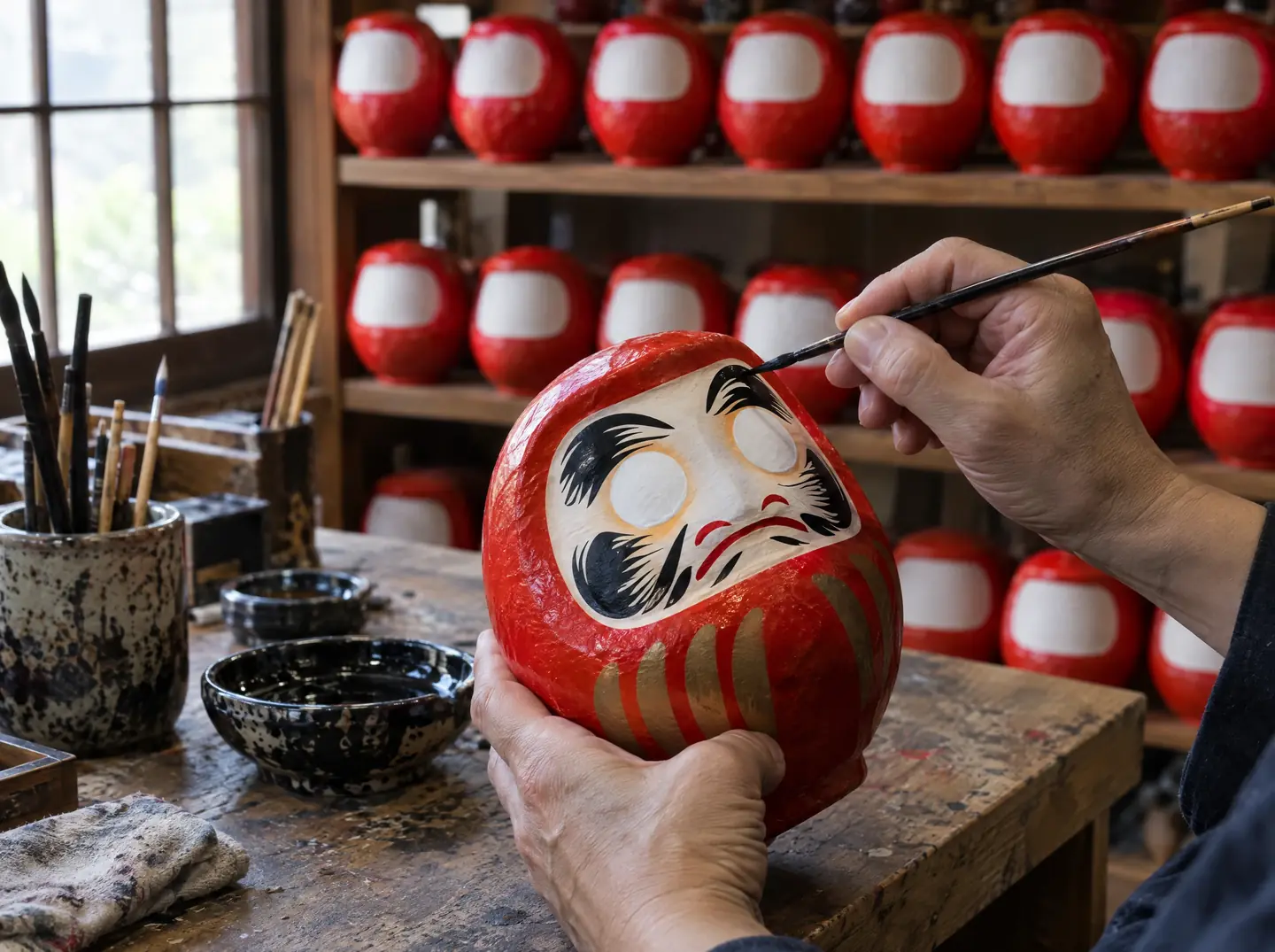
The story most often told goes like this. In the second half of the 1700s, farmers around Takasaki were having a hard time. The temple's ninth head priest gave them carved wooden molds and taught them to press paper over them to make three-dimensional Daruma, which they could sell at the temple's New Year fair. Sources disagree on the exact years. Some place it in the 1760s, others during the great Tenmei famine of the 1780s. All agree on the shape of the story: a temple, a mold and a winter side income for farming families.
The farmers made the dolls in the cold months, when there was no work in the fields. Silk farmers in particular took to them, since a good year depended so much on luck. Two centuries later, Takasaki is still the center of it. The city says around 80 percent of Japan's Daruma are made there.
How do you read a Daruma's face?
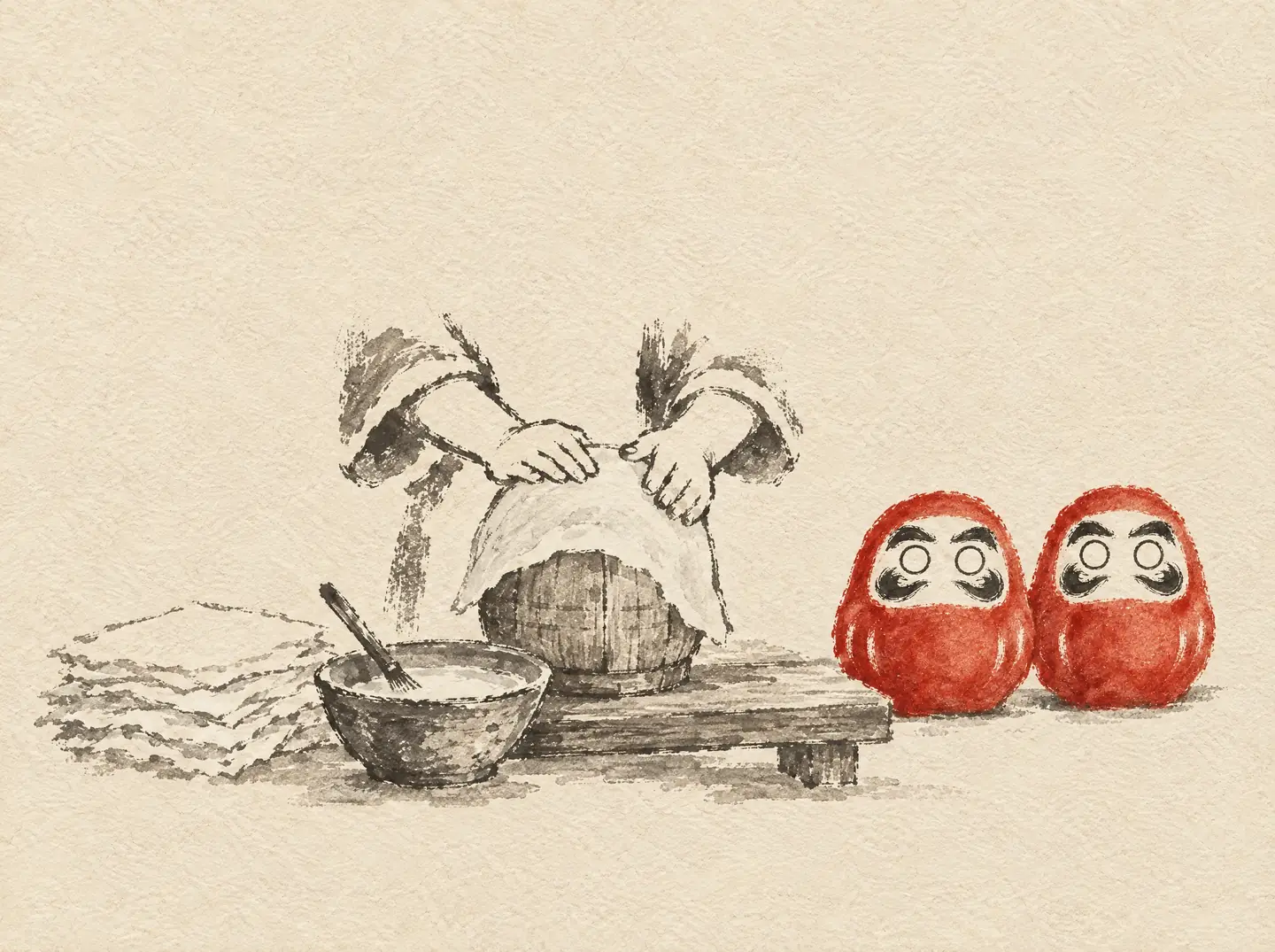
A traditional Takasaki Daruma has eyebrows painted as cranes and a beard painted as a turtle. Both are symbols of long life in Japan, from the saying that the crane lives a thousand years and the turtle ten thousand. Look closely at a classic Daruma and you will find the crane's wings in each brow.
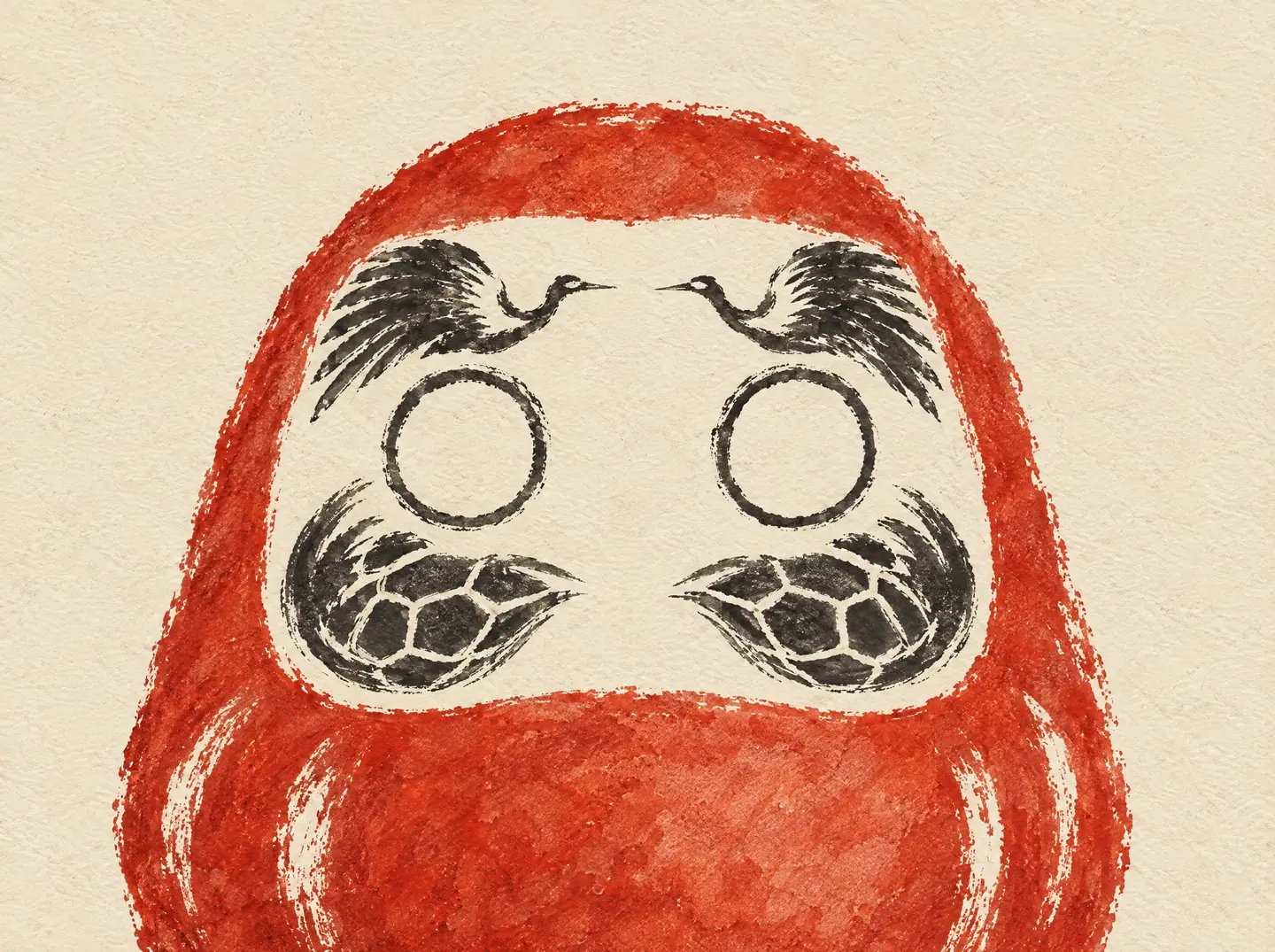
The rest of the doll carries meaning too:
- The red body. Red most likely comes from the color of a priest's robe, though no one is certain. In the late Edo period, red was also believed to keep smallpox away, and families bought red Daruma to please the smallpox god and to wish for recovery.
- The words on the belly. Many Daruma carry a character or phrase on their front, such as the kanji for good fortune.
- The weighted base. It keeps the doll upright, however many times it goes over.
What are the blank eyes for?
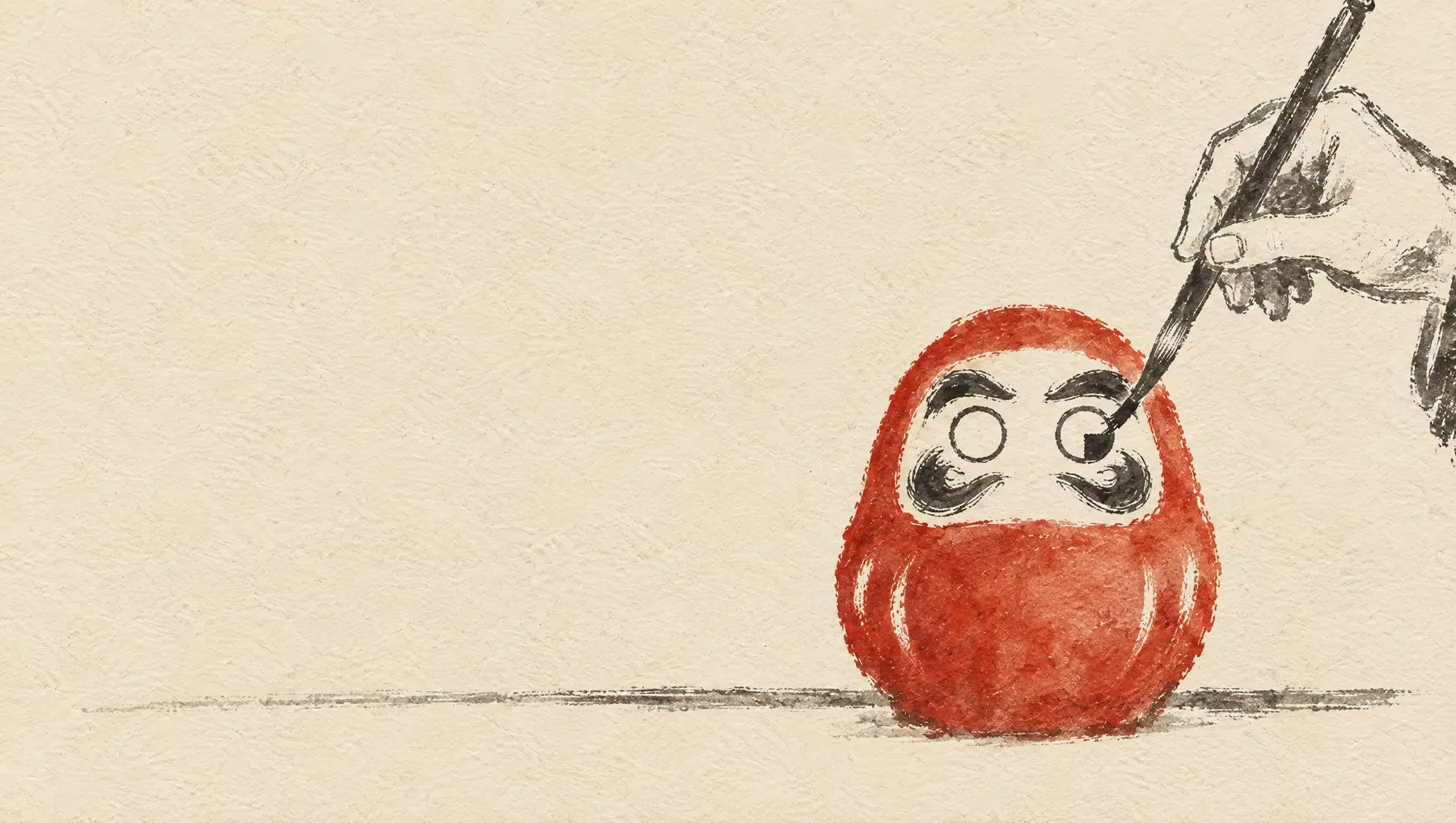
The eyes are the ritual. A Daruma is sold with both eyes white. You set one goal, paint in one eye, and keep the doll where you will see it. When you reach the goal, you paint in the other eye. There is a phrase for it: both eyes open.
That is the whole idea. A goal you can see every day is harder to forget than one written in a notebook. A doll looking at you with one eye is hard to ignore.
It shows up in public life too. At election time, large one-eyed Daruma sit in candidates' offices, and the second eye gets painted in on the night they win. Students buy them before exams. People opening a business buy one for the new shop.
For the full method, including which eye goes first, read How to use a Daruma doll.
What happens to a Daruma at the end of the year?
Many people in Japan return their Daruma to a temple around the New Year, where it is burned in a ceremony of thanks. The idea is that a charm has done its work after about a year, whether or not the goal was reached. Then you buy a new one and start again.
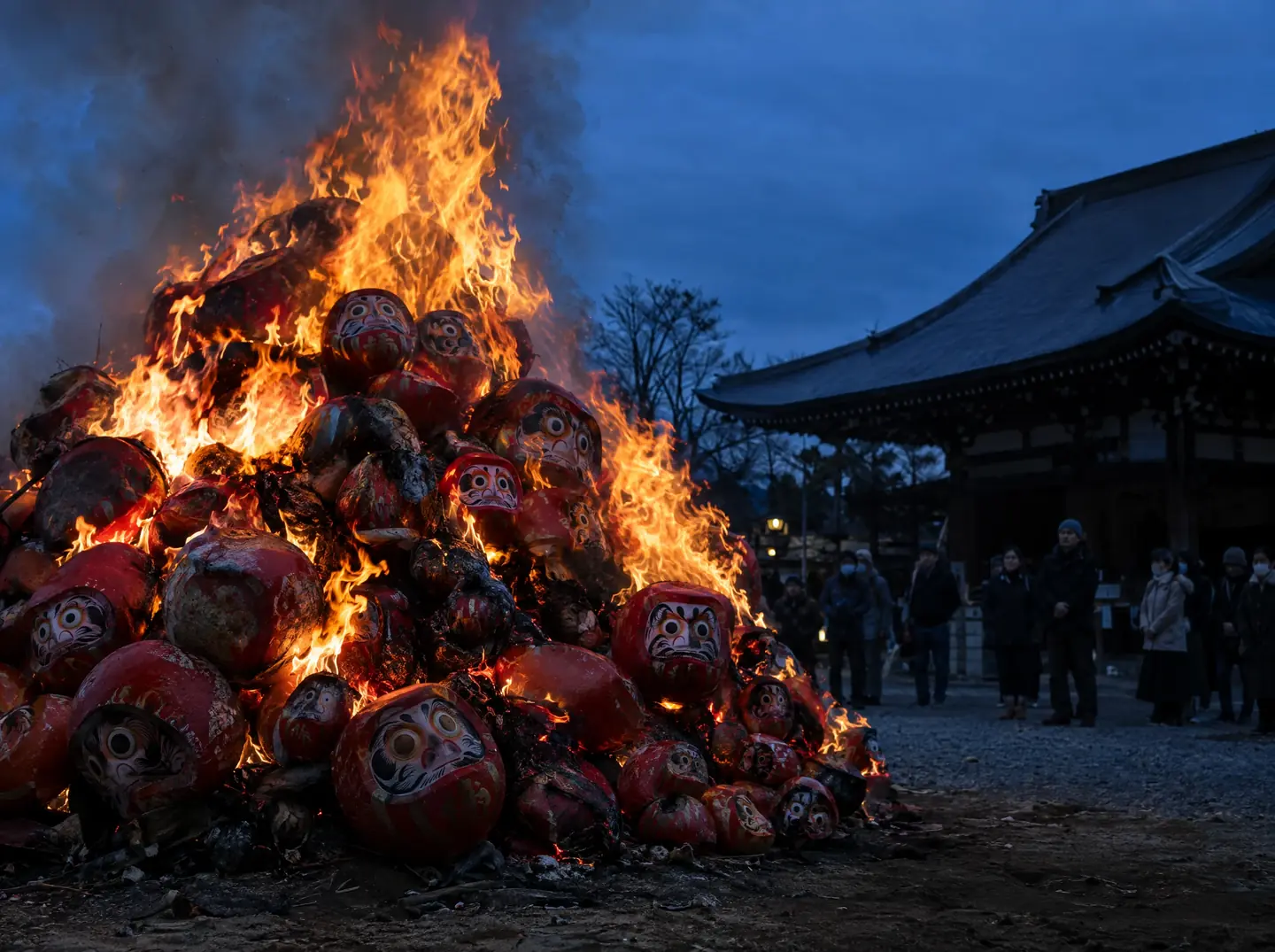
At Darumaji in Takasaki, monks light a bonfire of returned dolls every January. The temple describes it as a memorial service for the Daruma, and it is a respectful goodbye rather than a disposal. Similar ceremonies, called Daruma kuyō, take place at temples across Japan.
Why the Daruma still works
A Daruma asks for very little. One goal. One eye. A place on a shelf. It does not track your streak or send you reminders. It just looks at you, half finished, until you finish it.
That may be why it has lasted. Most of the things we use to keep promises to ourselves are loud. The Daruma is quiet, round and patient, and it always stands back up.
If you would like to start with your own, The Pair comes with two blank-eyed Daruma, a marker for the eyes and the ritual printed inside the lid. One for you, and one for someone you believe in.
Questions
What does Daruma mean?
Daruma is the Japanese name for Bodhidharma, a Buddhist monk traditionally credited with bringing Zen to China around the 5th or 6th century. The doll is a simplified, limbless portrait of him.
Why are Daruma dolls red?
Red is thought to come from the color of a priest's robe, though nobody is certain. In the late Edo period red was also linked to warding off smallpox, which helped make the red Daruma popular.
Where do Daruma dolls come from?
The round Daruma we know today is linked to Shorinzan Darumaji, a Zen temple in Takasaki, Gunma Prefecture. The city says around 80 percent of Japan's Daruma are still made there.
Why does a Daruma have no arms or legs?
Legend says Bodhidharma meditated facing a wall for nine years, so long that his arms and legs gave out. The doll's round, limbless body recalls that story.
What are Daruma dolls made of?
Traditional Daruma are papier-mâché, made by layering paper over a mold, then painted by hand. They are hollow and weighted at the bottom so they stand back up.
Sources
- Daruma doll, Wikipedia
- Shorinzan Daruma Temple, Wikipedia
- Takasaki Daruma, a Gunma icon, Visit Gunma
- Daruma fairs (January), Kids Web Japan
- Japan Reports, Vol. 48, No. 4, Consulate-General of Japan in Sydney
- Daruma, a symbol of perseverance and good luck, Stars and Stripes Okinawa
- Japanese festival says thank you and goodbye to Daruma good luck dolls with fire, SoraNews24
Written by The Orunoki team. We check every fact against the sources above and update the article when we learn more. Last updated .